Home / Resources / Blog / How to choose a takedown provider
How to Choose a Phishing Takedown Provider
Choose a phishing takedown service by what it can prove: what "removed" means, who files in whose name, and what happens when a site returns.
Article · Takedown · November 26, 2026 · 11 min read
By Anastasia S., Head of Enforcement
General information, not legal advice or an attorney-client relationship; rules differ by country, so ask counsel before legal notices or a UDRP domain dispute. Disclosure: bc.team is a managed takedown service, so we sell what this guide helps you buy. We rank no provider, and we note bc.team’s own practice where it applies. Last verified: November 25, 2026.
A phishing takedown service finds sites that impersonate your brand and gets the host, registrar or platform behind them to remove or suspend them. Buyers lose money on a ticket closed for a site still online. They lose it on a complaint that tells the operator who they are, and on a clone back the week after they pay. Crypto and fintech brands face wallet drainers, fake apps, ads and Telegram channels, so ask which a provider removes and which it only detects.
In short:
- Ask what counts as “removed”. Delisting hides a URL from search and the site stays online; a takedown makes the site or domain stop loading. See delisting vs takedown.
- Who files, under which name and authorization decides what the operator sees; the return definition and re-filing terms belong in the contract.
- Pick the model: a managed service if you lack an abuse desk, a platform if you have one, a law firm for a domain transfer. Then ask for a sample monthly report.
What Types of Phishing Takedown Services Are There?
Phishing takedown services come in three models: software platforms, managed services and law firms, which differ in who files and how you pay.
Pick the model before you compare vendors; it decides how much work stays with your team, which is step one in how to choose a brand protection vendor. An in-house abuse desk is a fourth option, with the registrar relationships and legal risk yours.
| Criterion | Software platform | Managed service | Law firm or IP counsel |
|---|---|---|---|
| What you get | Detection, a dashboard, evidence capture and often a filing workflow | Analysts who find, verify and file, plus reporting | Legal notices, UDRP (domain-transfer disputes) and court work |
| Who files | Your team, or the vendor’s team on request | The provider, as your agent | Counsel, for the trademark owner |
Many vendors blend models, so ask who sends each complaint, and what a monitoring-only vendor takes down versus only reports. A complaint filed in your name binds you in every model, so ask who pays if it is wrong (question 12). The UK’s NCSC advises asking about notices with legal compulsion.
What Should You Ask a Phishing Takedown Service Before You Sign?
Ask 12 questions about outcomes: what “removed” means, whose name is on the complaint, what happens when a site returns, and what proof you receive.
Take them to every vendor call, get answers in writing and score each 0 to 2. Make questions 1, 4 and 12 pass or fail, then pilot finalists on a few live fakes. Name one internal owner: security, legal, marketing and finance all touch this.
Which Questions Show What Counts as a Result?
Questions 1 to 3 define a result: what “removed” means, how a return is counted and what evidence each case includes.
Question 1: Does “removed” mean delisted, taken down or suspended? Delisting removes a URL from Google or Bing results; the site stays reachable by direct link. A host takedown disables the content. A domain suspension stops the name resolving, but the server may keep running. A browser or wallet blocklist removes nothing but warns visitors, so a good provider files to it too. Good answer: each complaint carries an outcome type, counted separately, with blocklist submissions listed. Weak answer: one “success” figure that mixes them.
Question 2: How do you define a return, and how long do you re-check? Clones return on new URLs, domains and hosts, and a success rate that ignores returns flatters the provider. Good answer: a written definition of a return, a re-check schedule with an end date, checks from the victim’s country, returns as their own line. Weak answer: “we monitor continuously”, with no window.
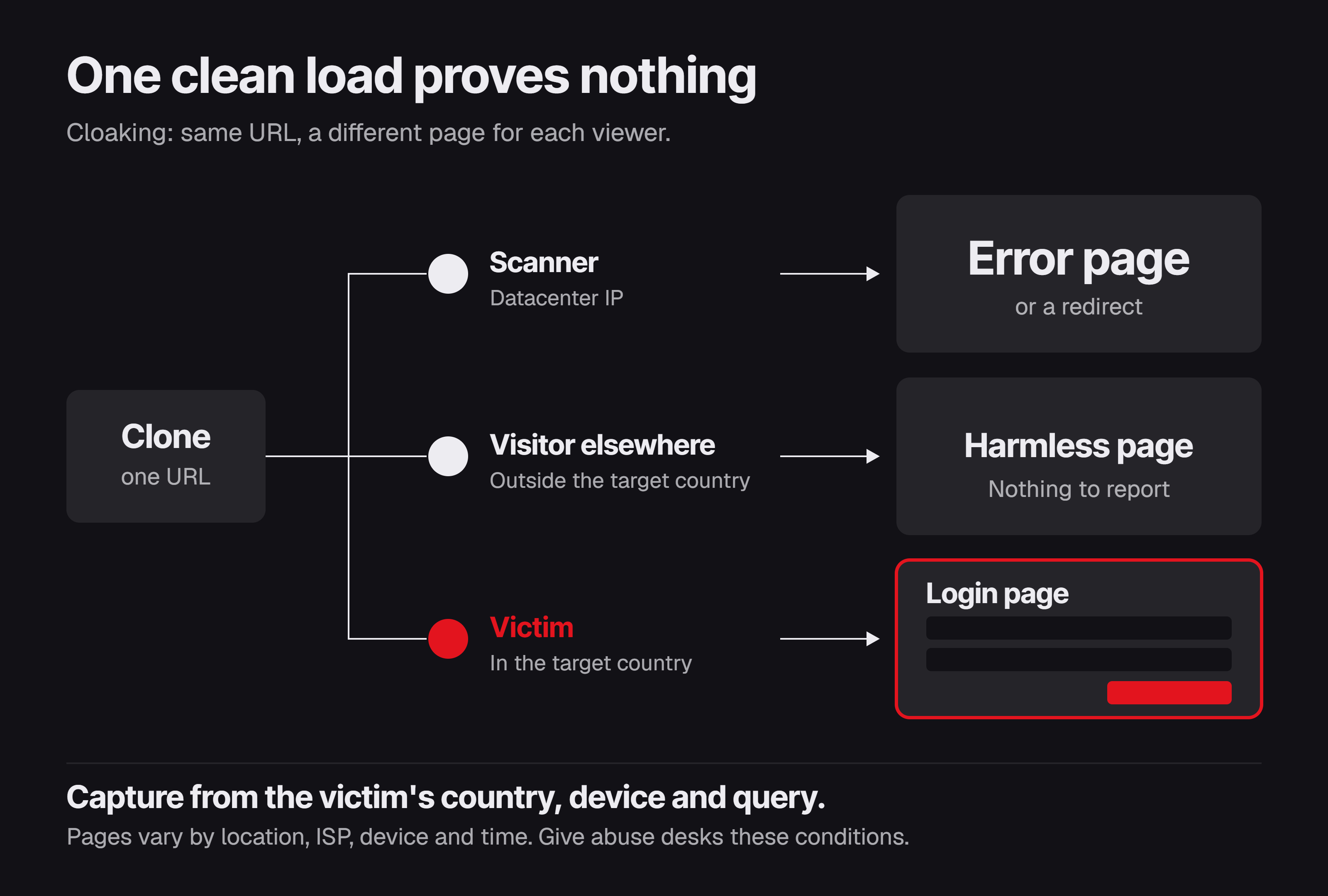
Question 3: What evidence do we receive for each case? Clones can show different pages to different visitors (cloaking), so one clean load proves nothing. An abuse desk that cannot reproduce a page may close the ticket. Netcraft documents crawlers served an error page or a harmless redirect, and Namecheap asks reporters for country and browser. Good answer: a dated capture from the victim’s country and device. It includes the redirect path, headers, host and registrar, page hash and reproduction conditions (country, device, referrer). Weak answer: a status code and “evidence on request”.
Who Files the Complaint, and What Does It Expose?
The provider files as your agent, so its claimant name, its letter of authorization (LOA) and the sites it checks shape your exposure.
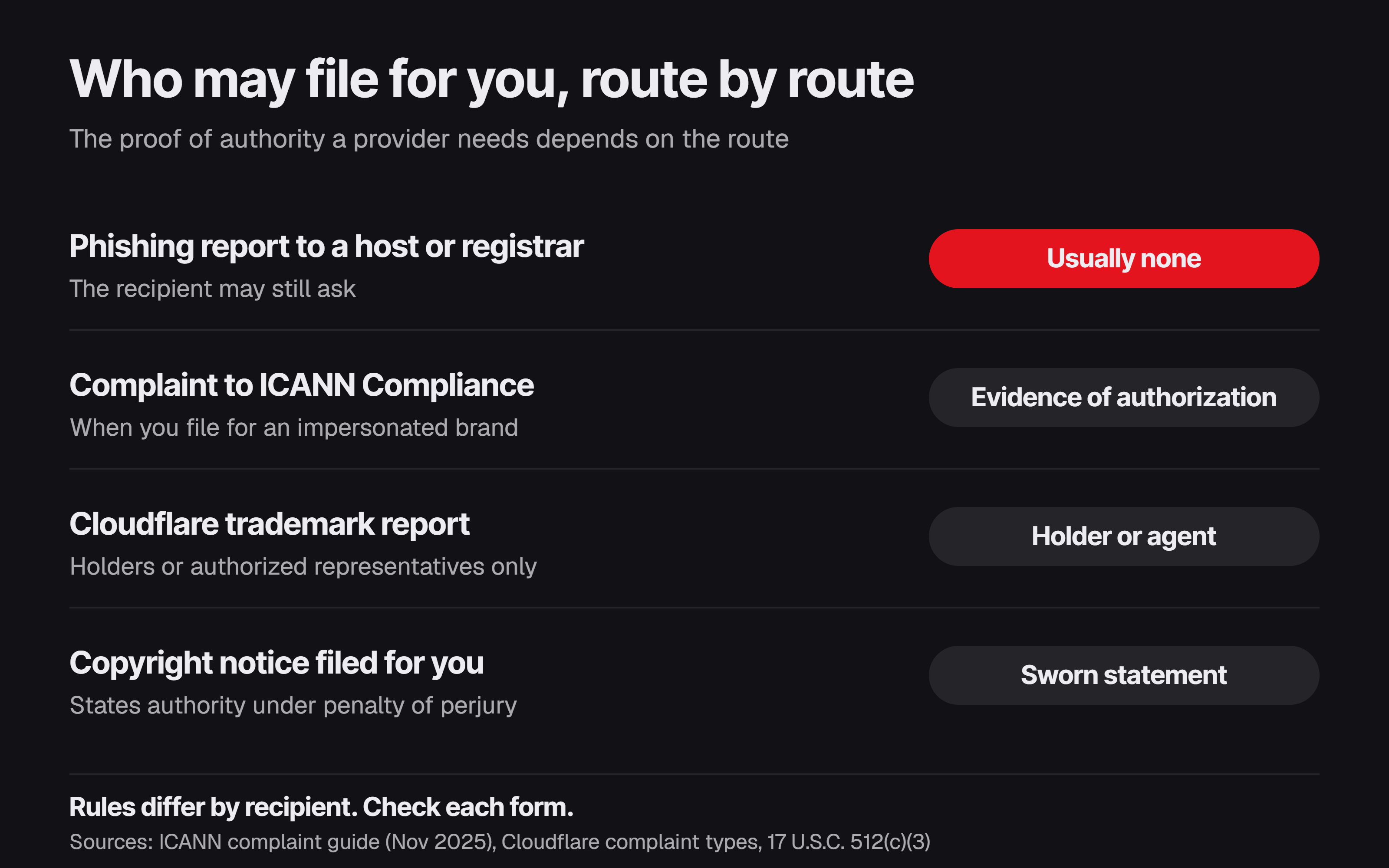
Question 4: Whose name and which authority are on each complaint? Google passes copyright and trademark notices to the Lumen database of takedown notices, which can show the requester’s name, URLs and explanation but never the contact fields. Cloudflare forwards reports to the host and operator, may pass reporter details to Lumen, and lets only phishing reporters withhold contact details. We found no public word on whether Safe Browsing reveals the reporter; ask. An LOA lets the provider act as your agent. Phishing reports usually need none, but ICANN’s complaint guide asks filers for an impersonated entity for evidence of authorization, Cloudflare accepts trademark reports only from holders or their representatives, and a copyright notice carries a sworn authorization statement. Good answer: one stable claimant name on every notice, and a sample LOA before you sign. The provider also lists, route by route, what is hidden and what needs an LOA. Weak answer: “our complaints are anonymous”, or a request for broad control of your domains. bc.team files as Global Digital Consulting LLC and requires a signed LOA before any filing.
Question 5: How do you avoid flagging our own backup sites, affiliates and agency sites? In December 2024 a registrar suspended an indie-games storefront’s whole domain over reports about one fan page; the companies involved denied fault (TorrentFreak). Good answer: you hand over domains, backup sites, affiliates and agency satellites before the first complaint. The provider asks you to confirm “not ours” before filing. The contract says who pays and how a mistaken complaint is reversed. Weak answer: the provider alone decides what is legitimate, or files automatically with no human review. bc.team works this way; see its post on SEO agency sites that look like clones.
How Far Does the Provider Reach?
Ask which surfaces, countries and depths the provider covers, how it finds hosts behind proxies, and how it routes each abuse type.
Question 6: Which surfaces do you take down, and what else do you submit to? Crypto brands face clones, wallet drainers, fake apps, paid ads, social accounts and Telegram channels. Each has a different lever: a clone goes to its host and registrar, an app to the app store, an ad to the ad platform. A drainer on a serverless or decentralized host may have no registrar lever. Ask what the provider removes and what it only reports. Ask whether it reports where stolen data goes, and whether it submits confirmed sites to browser and wallet blocklists. Good answer: a per-surface list of what it removes and what it only detects. Weak answer: “brand protection” with no such list.
Question 7: How deep and wide do you search? A clone on result page five, or visible in one country only, still takes visitors. Ask about depth (top 10 or top 100), countries, languages and devices. Ask where detection comes from (search, new-domain feeds, ad libraries, app stores), the gap between detection and filing, and who covers nights and weekends. Good answer: countries and queries per brand, plus a monthly list of what could not be checked. Weak answer: “global coverage”.
Question 8: How do you handle Cloudflare-proxied and offshore hosts? Cloudflare cannot remove content it does not host, so when it only proxies a site it forwards the report to the host and, after confirming phishing, shows visitors a warning page. It removes content it hosts itself, such as Pages sites. Good answer: how the real host is found, and who could act in each case (host, CDN, registrar and reseller, registry, upstream network). The provider also shows a redacted ticket ID from a real case. Weak answer: “we have relationships everywhere.”
Question 9: How do you route phishing, fraud and trademark abuse? Each ground goes to different places, and a registrar may class a deposit-only site as fraud, which falls outside DNS abuse. The registrar contract (RAA §3.18.2) requires prompt mitigation of actionable DNS abuse, which includes phishing. A registrar that is not the host may be unable to act until the abuse is validated. Good answer: a written sorting rule, and a fallback when a registrar refuses. Weak answer: one template for every complaint. The delisting vs takedown guide covers the routing.
What Happens After the First Filing, and What Do You Sign?
After filing, silent registrars get escalated, returning clones get re-filed, and the contract fixes cadence, term and record ownership.
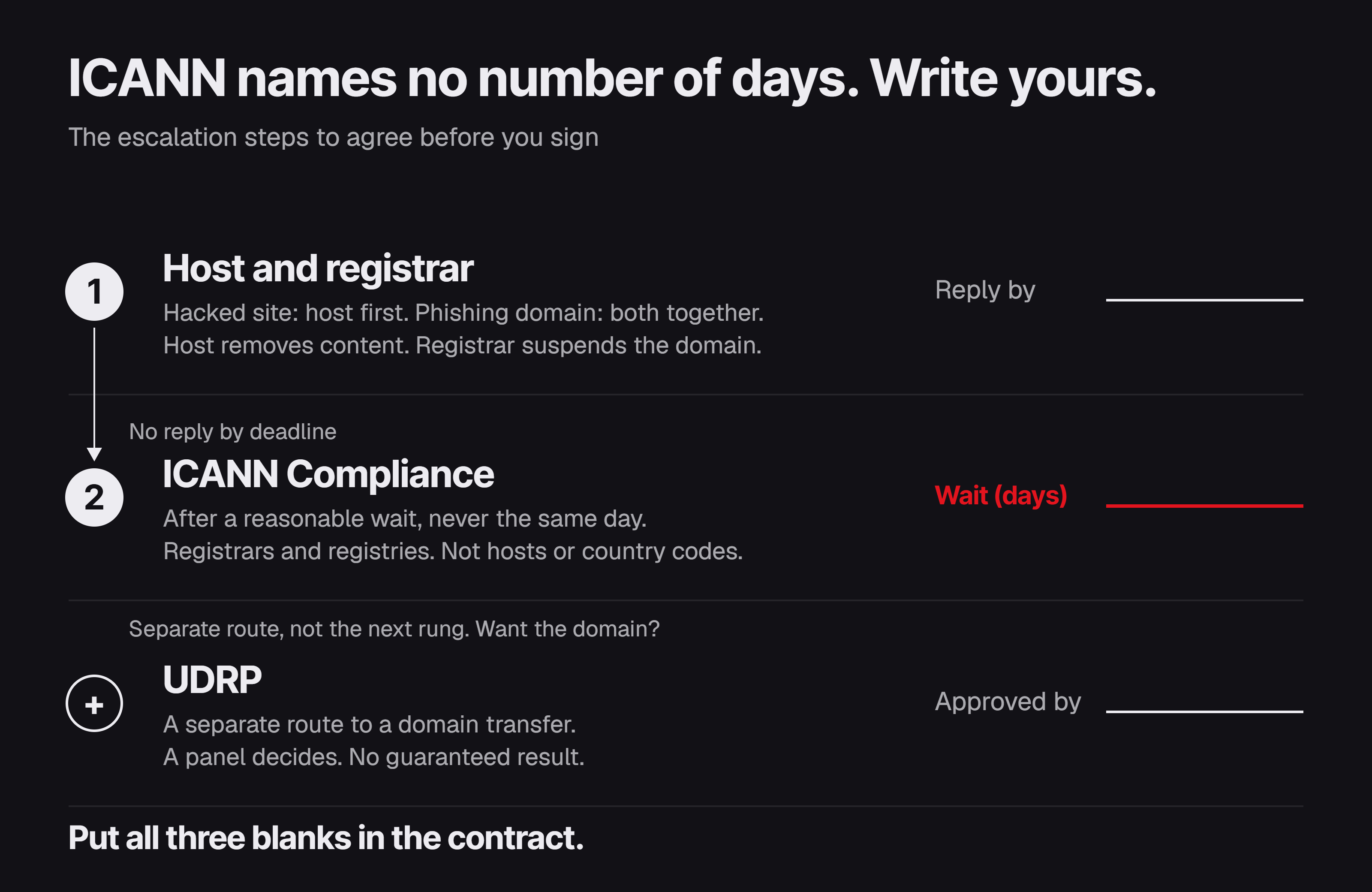
Question 10: When do you escalate, and who approves the spend? ICANN’s guide says to give the registrar a reasonable time before filing with ICANN. It names no number of days and says not to file with both on the same day. It covers registrars and registries, not hosts or country-code domains. For a hacked legitimate site, suspending the domain may be the wrong fix, so the host comes first. UDRP is a separate route to a domain transfer, decided by a panel with no guaranteed result. Good answer: a written escalation ladder with agreed deadlines, and UDRP only with your approval. Weak answer: a promised UDRP outcome, or UDRP billed by default.
Question 11: What happens when a clone returns, and is re-filing in the price? A search-delisting notice covers only the URLs it names, so a clone on a new domain needs a new complaint, filed after re-verifying. Good answer: re-filing is included and the return is reported. Related sites are mapped by kit fingerprint (page hash, scripts, where stolen data goes, registration pattern), not by shared IP or nameserver. Weak answer: every return is billed as a new case.
Question 12: What do the contract and the report commit to? Ask about report cadence, ticket-ID export, record ownership, term and exit, and data retention. Ask about security attestations (SOC 2 or ISO 27001), insurance, who pays if a complaint is wrong, and credit for a missed deadline. Good answer: a clear exit, with ticket IDs and records handed over when you leave. It offers a data-processing agreement, an export or API into your ticketing, and a sample report before signing. Weak answer: records stay with the vendor or no sample.
Which Red Flags Should You Look for in a Takedown Proposal?
Red-flag a proposal that says “removal” without saying where, quotes a success rate without a sample or promises a UDRP result.
- “Removed” with no location. Search, host, registrar or blocklist? Only some stop the site loading.
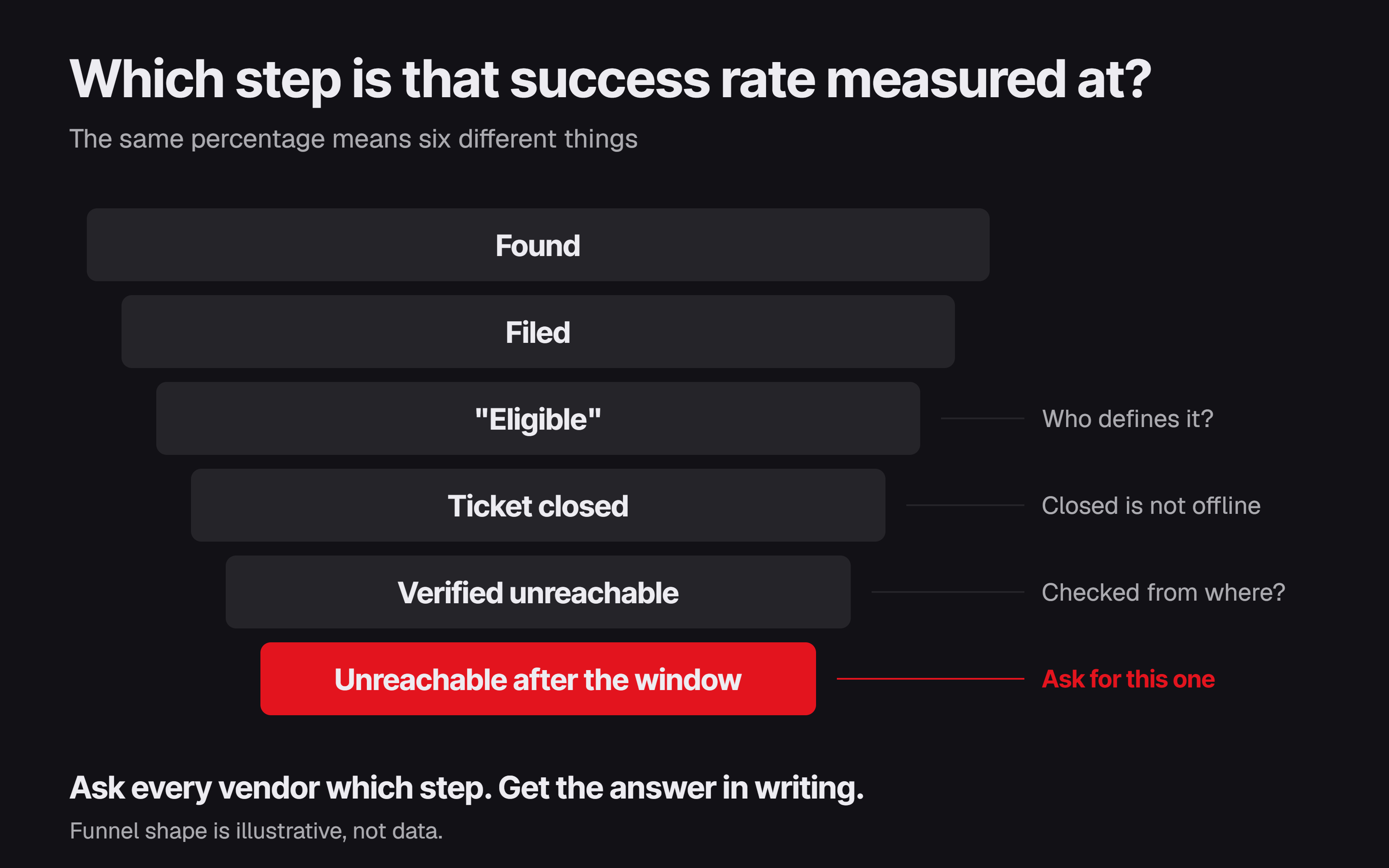
- A success rate without a method. Without a sample size, a period and a definition of “eligible”, the number cannot be checked. Even vendor guides say to ask how it is calculated.
- A guaranteed domain win. A UDRP panel decides each case, and the holder can still go to court (UDRP Policy ¶4(k)).
- A clock that starts late. “Within hours of our approval” measures the vendor’s queue, not your exposure. Ask which event starts the clock, and for a contractual time to first action, weekend cover and credits.
What Does a Good Monthly Takedown Report Look Like?
A good monthly report lists every complaint with its channel, dates and outcome type, shows returns, and says which countries it could not check.
bc.team’s how we report page and sample report PDF show one format with fewer columns: no “Verified on” field and no separate delisting-versus-takedown label.
| Column or section | What it tells you |
|---|---|
| Site and where found | Country, query and position; domain masked in shared copies |
| Filed on | Channel (Google, Bing, Cloudflare, host, registrar) and the date and time sent |
| Outcome type | Delisted, host takedown, domain suspended, blocklisted, pending |
| Verified on | Date and country of the re-check |
| Return flag | Whether the site came back, and when |
| Not checked | Countries, platforms or queries not covered |
| Quarterly summary | One page for your board: new, offline and verified, returned and still live |
How Much Does a Phishing Takedown Service Cost?
Takedown services are priced by subscription, by pack or by case, and most quotes are private; the one public benchmark here is WIPO’s UDRP fee.
Platforms often sell an annual subscription scoped by brands or assets; managed services often charge per brand or per pack of takedowns; law firms often bill per case or by the hour. WIPO’s published fee for one to five domains is USD 1,500 with a single panelist and USD 4,000 with three (checked November 25, 2026), plus counsel fees. bc.team prices per brand and publishes no list price; see the pricing page. Ask every vendor to price the same scenario: your brands, countries and one UDRP. Ask each to state volume included, overage, credit for failures and returns, and term.
FAQ
Buyers mostly ask which provider is best, who can remove a clone, whether it works and what it costs.
What Is the Best Phishing Takedown Service for Clone Websites?
No provider is best for every brand: the best phishing takedown provider is the one whose written answers to the 12 questions fit your case.
For clone websites, weigh four answers most. Does the report separate delisting from takedown (question 1)? How does it define returns (question 2)? Which surfaces and blocklists does it cover (question 6)? How deeply does it search your branded results by country (question 7)?
Who Can Take Down a Phishing Site That Impersonates My Crypto Exchange?
Yes: the host can remove the site, the registrar or registry can suspend the domain, and a takedown service files both reports as your agent.
Which party can act depends on the surface. A web clone goes to its host and registrar, a fake app to the app store. An ad goes to the ad platform, a social or Telegram account to that platform. Google Safe Browsing and wallet blocklists such as MetaMask’s phishing list flag sites and do not remove them. A provider acting as your agent may need an LOA for some routes (question 4). A deposit-only site may be classed as fraud, outside DNS abuse (question 9).
What Are the Best Brand Protection Services for Crypto Companies?
No provider is best for every crypto company; choose one that reports outcomes by type, names its claimant and shares a sample report before you sign.
For a crypto exchange, ask what the provider covers: fake login pages, wallet-drainer sites, fake airdrop and support pages, impersonated Telegram, X and Discord accounts. Ask whether it submits to wallet blocklists. Ask whether it has a process for your own backup sites and affiliates.
Do Brand Protection Takedown Services Actually Work?
Yes, when you measure outcomes that matter: sites that no longer load, returns tracked, and each complaint traceable to a result.
Ask any provider for its per-complaint report.
How Much Does Brand Protection Cost?
Brand protection is priced as a subscription by brand or asset, a pack of takedowns or a fee per legal case; most enterprise quotes are not published.
bc.team’s pricing page lists the modules and how to get a proposal.
Get a Free Brand Audit
Get a free brand audit to see who appears for your brand name in each country, where each link leads and what can be removed.
Use the brand audit as a test of any provider, us included: compare what it finds with each vendor’s answers to questions 1 to 3 and 7.
Sources
- Cloudflare: abuse approach, complaint types, abuse report API.
- Google: Lumen sharing, copyright removal FAQ, Safe Browsing report form.
- ICANN: RAA §3.18.2 advisory, DNS abuse complaint guide.
- WIPO: UDRP guide, fee schedule. ICANN: UDRP Policy.
- Registrars: RrSG guide to registrar abuse reporting, Namecheap abuse reporting.
- Netcraft: cloaking and geofencing.
- US law: 17 U.S.C. §512.
- UK NCSC: takedown guidance, protect your customers to protect your brand.
- Pricing structures (vendor pages, used only as examples of structure): ZeroFox, PhishFort.
About the Author and bc.team
Anastasia S. is Head of Enforcement at bc.team, where she works on complaint filing across search engines, hosts, registrars and platforms.
Related articles
Takedown · 12 min read
What 'Removed' Really Means: Delisting vs Takedown
Delisting hides a page from search. A takedown stops the site or domain. What each does, who sees your complaint and what to file first.
Takedown · 4 min read
Why a clone comes back after a takedown
Clone domains are disposable. We take down the whole network, then fill search results with your content.
See who's profiting from your brand
Send a request. Within 1 business day we'll show you who is making money off your name and what we can take down. Free.