
Home / Resources / Blog / Delisting vs takedown
What 'Removed' Really Means: Delisting vs Takedown
A clone of your site can be "removed" and still be online. After a website takedown request, a platform may hide the page from search, show a warning, switch off the server or suspend the domain. Each outcome reverses differently, and each tells different people that you complained.
Article · Takedown · November 22, 2026 · 12 min read
By Anastasia S., Head of Enforcement
General information about publicly documented processes, not legal advice. bc.team is not a law firm, rules and platform policies change, and counsel should review any notice before you send it.
In short:
- Delisting removes a URL from search results, and the site stays online. A website takedown makes the site or its domain stop working. The host, registrar or registry does that; Google cannot.
- A fake login or deposit page is a phishing case. Report it to the host and registrar together, on the same day, to get the site taken down. If the clone also copies content you own, add a DMCA notice to Google.
- Both outcomes can be undone, and the operator can often see who complained.
- Delisting cuts traffic while the host and registrar decide.
What Is the Difference Between Delisting and a Website Takedown?
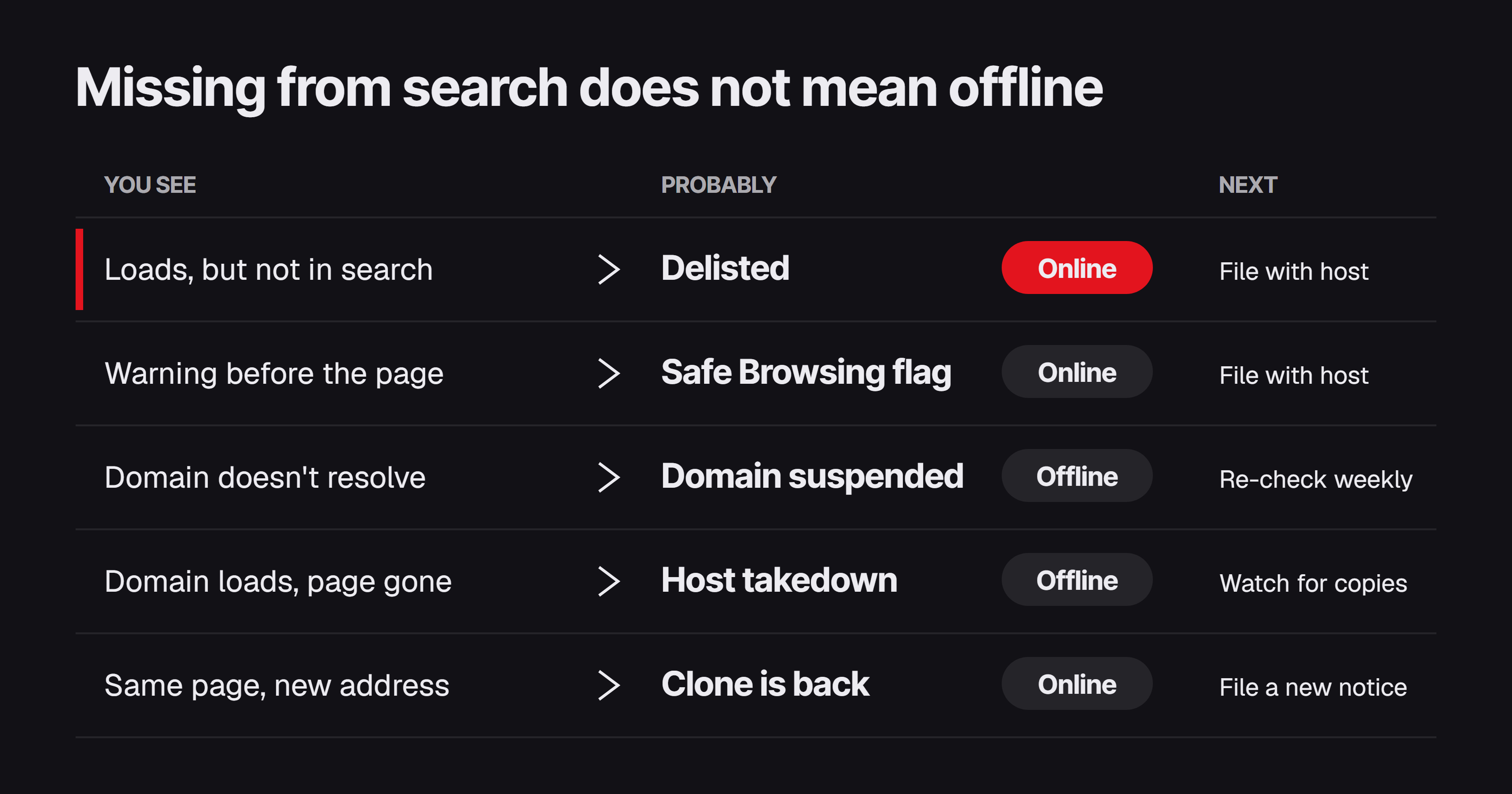
Delisting removes a page from search results while the site stays online. A website takedown makes the site or its domain stop working.
The delisting vs takedown question comes up the moment a provider says “removed”. Ask which of the two it means, because the answer decides what you pay for and how you check the result.
Delisting is when a search engine such as Google or Bing removes a URL from its results on request. The page stays online and opens by direct link. A DMCA notice, which is a copyright complaint under US law, usually triggers it. The word here means search removal, not a token or stock delisting, and some vendors say “de-indexing”. Google’s help says it can only remove things from Search results, and that they might still be on the internet.
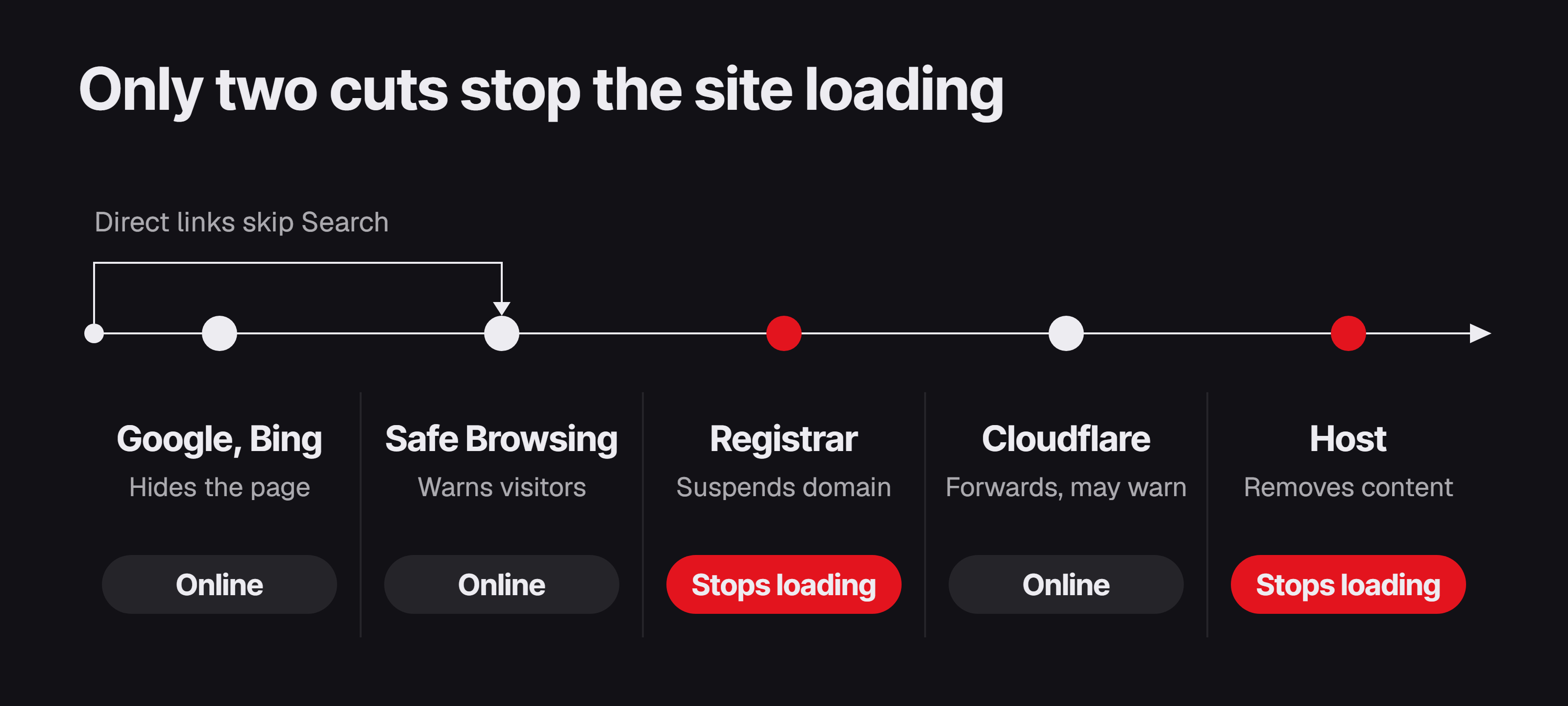
A website takedown is when a host, registrar or registry disables the content or the domain so that it no longer loads. It comes in two forms:
- At the host. The content is deleted or disabled. The domain stays registered, so the operator can point it at a new host.
- At the registrar or registry (a domain takedown). The domain is suspended and stops resolving. The server may keep running under a new name.
A Cloudflare proxy does not host the site. Cloudflare says it cannot remove content it does not host, so it forwards your report to the host and may show a phishing warning page. Where Cloudflare is the host or the registrar, it can act directly.
What Is a Domain Takedown?
A domain takedown is when a registrar or registry suspends a domain so it stops resolving, while the server behind it may keep running.
To request one, find the registrar in ICANN’s lookup and send its abuse contact a report with dated evidence. For phishing, cite RAA §3.18.2. The operator can register a new domain and point it at the same server, so a domain takedown works best alongside a host takedown.
Is the Site Still Online After Each Kind of Removal?
No: delisting and warnings leave a clone online, and only a host takedown or a domain suspension stops it loading.
| Outcome | Still online? | Can it be reversed? | Who sees your complaint? |
|---|---|---|---|
| Delisted from Google or Bing | Yes. Reachable by direct link, social posts, ads and other search engines. | Yes. The owner can file a counter-notice, or you can retract. A clone on a new URL is not covered. | Google: a copy goes to the Lumen database, and a notice can appear at the bottom of the results page. Bing: aggregate reports published; individual-notice practice not confirmed. |
| Safe Browsing warning | Yes. Chrome and some other browsers show a full-page warning, which can be clicked through. | Yes. The owner cleans the site and requests a security review. | Unknown. Google’s public pages do not say whether your details reach the site. |
| Site removed at the host | No, at that host. Cached copies may linger. | Yes. The customer can dispute it or upload the site elsewhere. | Varies by host; assume the customer sees it. Behind Cloudflare, the report goes to both host and operator. |
| Domain suspended | Stops resolving once caches expire. The server may still run. | Yes. The registrant fixes the issue and asks for the hold to be lifted, or registers a new domain. | Assume yes. A registrar may notify the registrant, site operator and host. |
| Domain transferred through UDRP | Until the transfer, yes. After it, what the domain shows is your decision. | Hard. UDRP has no appeal, but the former holder can go to court. | The holder receives the complaint, and WIPO publishes its decisions online. |
To check which outcome you got:
- Open the exact URL in a private window on mobile data, then on office Wi-Fi, and screenshot it with the date. Clones often show different pages to different visitors, so one clean load proves nothing.
- Paste the domain into ICANN’s lookup. A status of
clientHoldorserverHoldmeans the domain is suspended. - Search the exact URL and the brand query. A delisting may show a Google notice at the bottom of the results; do not rely on
site:searches. - Repeat after 24 and 72 hours, because caches can show the old state.
The full routine is in our guide on how to check that a complaint was accepted. For channel timings and letter-of-authorization (LOA) requirements, see the channel table.
How Do You Get a Website Taken Down, and in What Order?
Report phishing to the host and registrar, file delisting alongside it to cut traffic, and use UDRP only to own the domain.
“Legally” here means the processes that platforms and the law provide: abuse reports, DMCA notices for content you own, and UDRP. None of them needs a court.
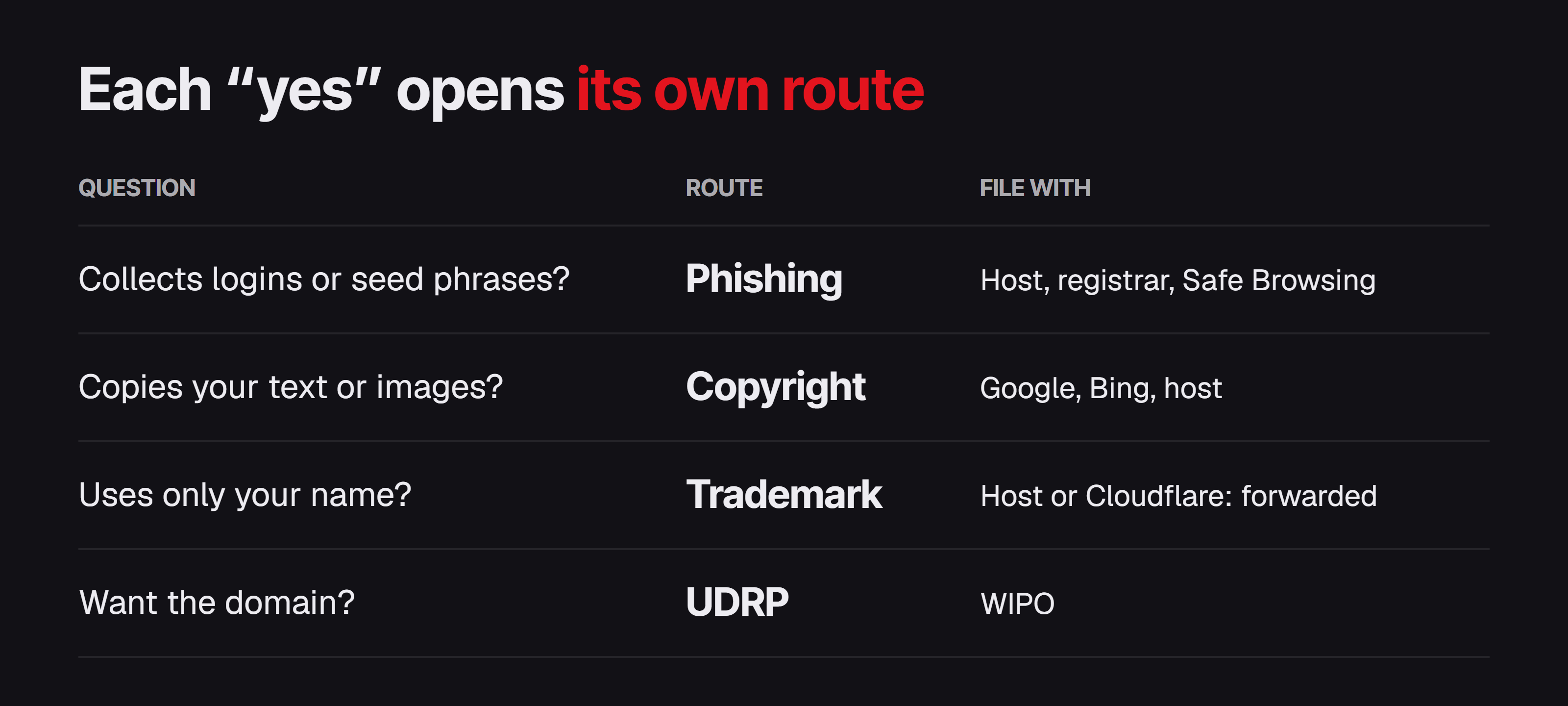
- Sort the case. If the clone collects logins, card data or wallet seed phrases, report it as phishing. Phishing and fraud reports generally do not need a rights-holder letter, but check each form. A site that only takes deposits is fraud or impersonation, so lead with the host; registrars treat fraud separately from DNS abuse. If it copies original text or images that you own or are authorized to enforce, add a copyright notice. Names, slogans and simple logos are generally not copyrightable; original logo artwork may be.
- Check that it is really yours to report. Affiliates, licensees and review sites may use your name lawfully. An identifiable operator may respond better to a cease-and-desist or a contract notice than to a platform report. If the page sits on a hacked legitimate site, ask the host and the site owner to clean it. That is the route for a compromised site. If a page shows your brand to Google but sends visitors elsewhere, that is cloaking or affiliate abuse. Report it as webspam or through the affiliate program.
- File on the same day. For phishing, ask the host for a takedown and the registrar for a suspension. Add a Safe Browsing report. Keep it all in one ticket that contains only phishing. File copyright and trademark routes separately, because hosts handle them through notice-and-forward processes. Ask Google and Bing for delisting only where you have a copyright or counterfeit basis. If the clone is part of a network, map it first (shared IP, nameserver, certificate) and then file in one burst. ICANN’s lookup shows the registrar and its abuse contact; the abuse contact listed for the site’s IP address reaches the host or its upstream. Behind Cloudflare or another proxy, report through the proxy, which forwards it. If a vendor files for you, expect to sign an LOA, because some hosts and registrars ask for proof of authorization.
- Escalate a silent registrar. Since 5 April 2024, RAA §3.18.2 requires registrars to act promptly on actionable evidence of DNS Abuse: malware, botnets, phishing, pharming, and spam that delivers them. Cite it in phishing reports. ICANN’s complaint guide says to wait a reasonable time, then file with ICANN Compliance and attach your earlier report. Do not send the two on the same day. It gives no number of days, so agree a deadline with your provider and write it in the first report. ICANN covers gTLD domains only, and has no authority over hosts. If the host and the registrar both ignore you, report to the registry operator or the host’s upstream network. For a country-code domain, follow the registry’s own process. If nothing moves, delisting and Safe Browsing keep cutting traffic while you escalate to the next channel.
- Add a trademark complaint where it fits. Google’s counterfeit policy covers pages selling counterfeit goods, so for a name-only clone lead with the copyright or phishing grounds that apply. Registrars send trademark disputes over a domain to UDRP, URS or a court (Namecheap, OpenSRS), and ICANN places such complaints outside its authority. Cloudflare takes trademark reports from holders or their representatives and forwards them to the host and the operator. File one alongside the other routes.
- Use UDRP when you want the domain. You must show three things. The domain is confusingly similar to your trademark. The holder has no legitimate interest in it. It was registered and is used in bad faith (UDRP Policy §4(a)). A panel can order only a transfer or cancellation. WIPO says a case should normally finish within about 2 months. The registrar then waits ten business days, and a court filing by the holder stops the transfer. Start UDRP once the takedown has been tried or has stalled, because it tells the holder you are coming. UDRP is a procedure run by WIPO and other providers, and a panel decides each case. A complaint filed in bad faith can be found to be reverse domain name hijacking.
- Re-check and re-file. Look at the clone and at search again, keep a dated log, and file again through another channel if a platform stays silent.
How Can a Removal Be Reversed?
A counter-notice, a security review, a lifted hold or a court action can reverse a removal. A clone can also reappear on a new URL.
How Does a DMCA Counter-Notice Reverse a Delisting?
A site owner can file a counter-notice, and Google may restore the link if the complainant starts no legal proceedings within 10 business days.
For hosted material, 17 U.S.C. §512(g)(2)(C) conditions a host’s safe harbor on restoring the material 10 to 14 business days after a counter-notice, unless the complainant has sued; non-US hosts are not bound by it. Google runs its own process for Search, which it ties to §512(g). Its help page gives 10 business days and requires that the content not break another Google policy. The sender must give contact details, swear under penalty of perjury that the removal was a mistake, and consent to a US federal court’s jurisdiction. Only the original complainant can retract a notice.
If a counter-notice reaches you, you have that window to start a court action, or the URL may return. Under §512(f), anyone who knowingly and materially misrepresents that material is infringing is liable for damages, including costs and attorneys’ fees, and the Copyright Claims Board hears such claims for up to $30,000. File a DMCA notice only for works you own, hold exclusive rights in or are authorized to enforce, and consider fair use first.
Can a Clone Come Back After a Delisting?
Yes, a clone can come back, so every new URL or domain gets its own notice. A notice removes only the URLs it names.
Google asks you to name the specific URLs you want removed. It does not say that a removal fails to carry over to new URLs; that is our reading of the per-URL rule. If a notice removes clone.example.com/login, the same page at clone.example.net/login needs its own notice. Why a clone comes back after a takedown covers the causes.
Who Learns That You Complained?
The operator can often find out who complained: Google copies notices to Lumen, and Cloudflare forwards reports to the host and the site operator.
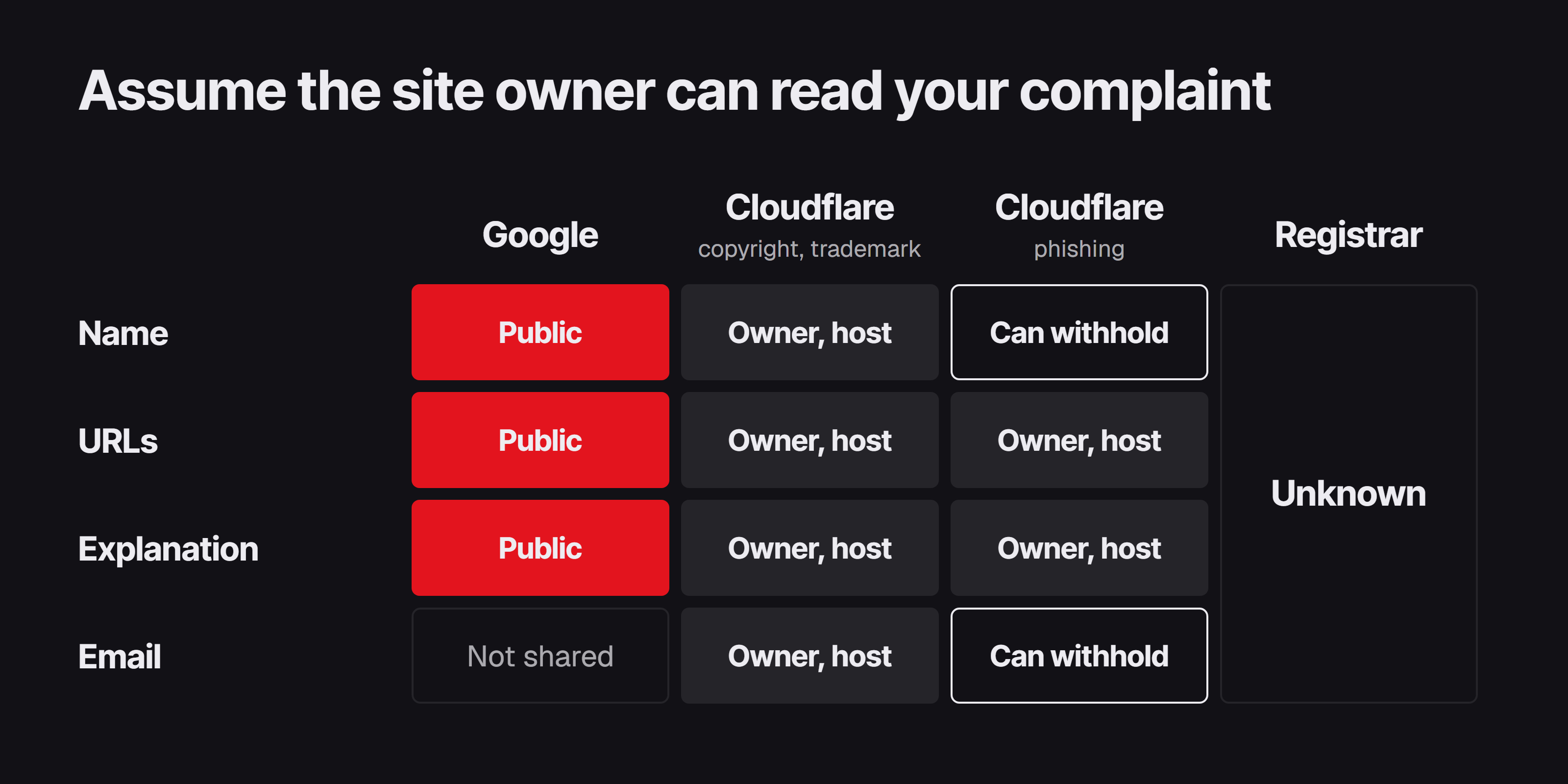
Google shares copyright and trademark notices with the Lumen database, per its Lumen help page: your name, the rights holder, the reported URLs, your explanation and a quote of the allegedly infringing content. It never shares the contact fields, such as your email. A link to the notice can appear at the bottom of the affected results page. Bing publishes aggregate figures; individual-notice practice is not confirmed.
Cloudflare forwards abuse reports to the hosting provider and the website operator. Its API documentation says copyright and trademark reports cannot be anonymous, so your contact details reach both and may be released to third parties such as Lumen. For some other types, such as phishing, you can ask Cloudflare to withhold them. Assume a registrar’s customer can learn of your report too.
What Should You Do About Complaint Exposure?
Assume the operator will read the complaint, so file under one stable name and keep private data out of it.
- Use one claimant name. Platforms and operators see it on every notice, and Lumen makes it public, so use the name you want attached to the claim.
- Keep private data out of the explanation field. Google passes it to Lumen. Withhold your contact details wherever the form allows it.
- Save dated evidence first: the page and the search result, with country and query, captured from the victim’s country and device.
- Expect a move to a new domain. Re-check weekly, and look for sibling domains on the same IP, nameserver or certificate.
What Should You Ask Website Takedown Services?
A good takedown service files every route, follows up and re-checks, and reports each outcome by name.
Before you hire a website takedown service, ask for:
- the meaning of “removed” in each report: delisting, host takedown, domain suspension or transfer;
- the status of every complaint, and the re-check history;
- the name on each notice, and whether they report through Cloudflare and withhold your contact details;
- time to offline and time to re-file when a clone returns, per channel;
- whether and when they escalate to ICANN Compliance.
Timing differs by channel and provider, and ICANN does not set one time for “prompt”. Channel timings are in the channel table.
A free brand audit shows who appears for your brand name in the countries you list, where each link leads and what can be removed. How bc.team handles fake websites and clones is on the service page.
FAQ
How Do I Remove a Clone of My Casino Site from Google?
Yes: if the clone copies content you own or control, file a DMCA notice with Google, and the URL can leave results.
File as the owner, an exclusive licensee or an authorized agent. The site stays online, so also report it to its host and registrar, as phishing if it collects logins or seed phrases. If the clone only uses your name, lead with the phishing or copyright grounds that apply. File again for every new URL. See Google and Bing remove different things.
How Do I Remove a Fake Crypto Exchange Website That Impersonates My Brand?
Yes: if it collects credentials or seed phrases, report it as phishing to the host, registrar, Cloudflare and Safe Browsing, and aim for a takedown.
If it only takes deposits, it is fraud or impersonation, so lead with the host and report the deposit addresses. Cite RAA §3.18.2 for phishing if a registrar is silent. If the domain uses your trademark and you want it, consider UDRP.
Do Brand Protection Takedown Services Actually Work?
Yes: a takedown service files the complaints that get a clone delisted, taken down or suspended, and files again when it returns.
How Do I Push a Clone Down in Branded Google Search Results?
Yes: publish your own sites and content for the same searches, so official and independent pages outrank the clone.
Sources
- Google: Search Help on removal, counter-notice, Lumen, copyright removal FAQ, legal removals, counterfeit goods policy, Safe Browsing review.
- US law: 17 U.S.C. §512, Copyright Office Circular 33, Copyright Claims Board FAQ.
- Cloudflare: abuse approach, complaint types, abuse report API.
- ICANN: RAA amendment, 5 April 2024, DNS Abuse advisory, complaint guide, trademark complaints, UDRP Policy, lookup.
- WIPO: UDRP guide, decision search.
- Registrars: Namecheap, OpenSRS.
- Microsoft: Copyright Removal Requests Report.
About the Author and bc.team
Anastasia S. is Head of Enforcement at bc.team, where she works on complaint filing across search engines, hosts, registrars and platforms.
Related articles
Takedown · 4 min read
Why a clone comes back after a takedown
Clone domains are disposable. We take down the whole network, then fill search results with your content.
Crypto · 4 min read
A “blank page” that posed as an exchange login
A check marked six sites empty. All six were live, and three posed as an exchange sign-in.
See who's profiting from your brand
Send a request. Within 1 business day we'll show you who is making money off your name and what we can take down. Free.